Showing posts with label Hosta. Show all posts

Tuesday, September 2, 2014

Slug and Snail Killer

I do not have much of a problem with snails or slugs anymore.  They are the bane of Hosta gardeners, and indeed, I have fought a few battles with them in the past.  Now whenever I find I have some, which is rare, I bring out my big guns.

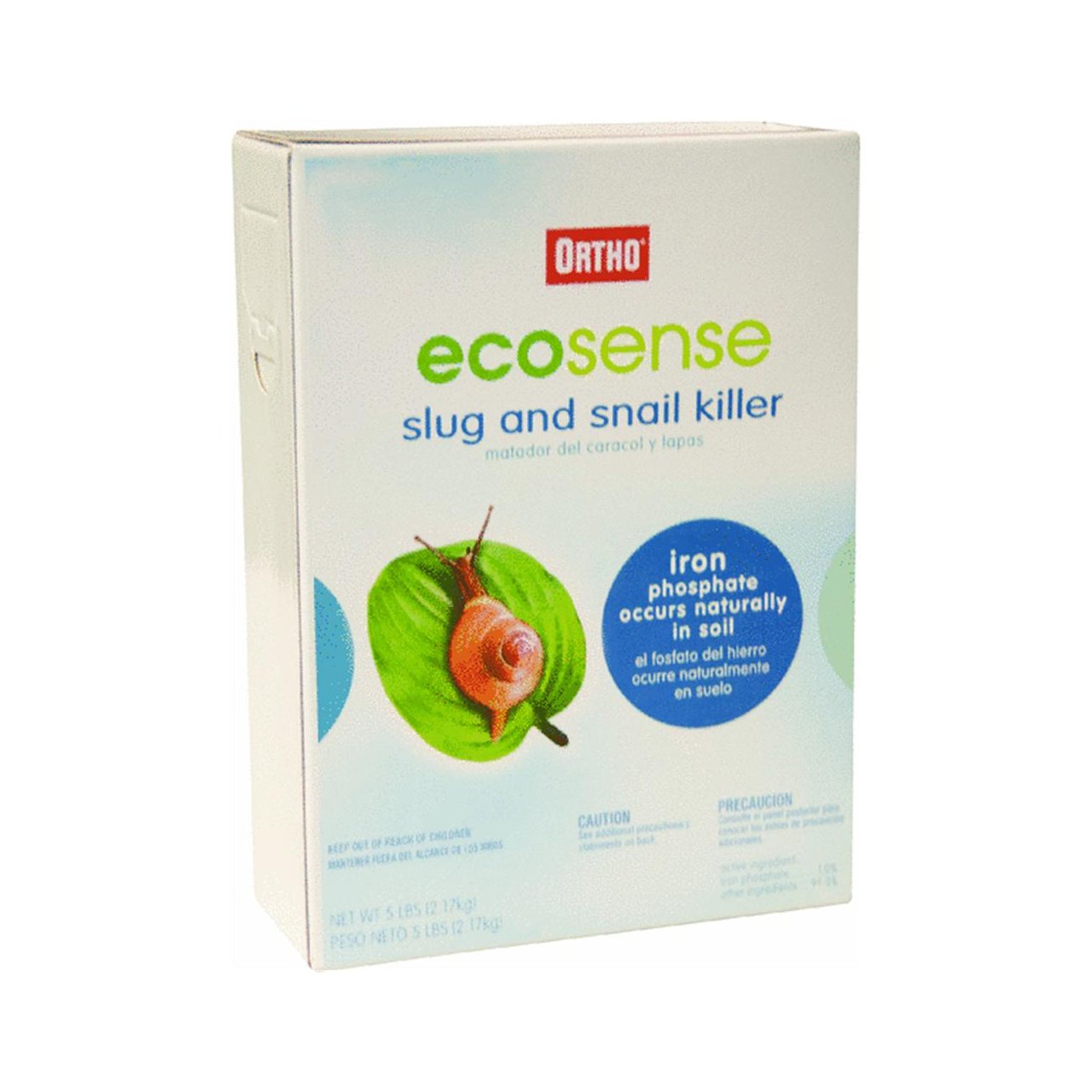
What is my secret weapon?  Slug and snail killer with the active ingredient of iron phosphate.  The last I bought was made by Ortho and I found it in the lawn and garden section of a local store, but there are other brands such as Escar-Go! and Sluggo to name a couple.

How does it work?  The iron phosphate shuts down the snail or slug's digestive system and it starves to death.  You do not see them laying around dead, but you gradually see less damage, then eventually no more.

How do you use it?  Sprinkle it around affected plants and the snails are drawn to.  I recommend hiding it under the plants so that it does not become expensive bird feed.

What are its advantages?  It is organic and gradually reverts back to the soil.  It is fast and easy to use.  It is safe to use around pets and kids.  It lasts through rain and watering without needed to be reapplied.  It works better than anything else I have tried.  In the early days I went through quite a bit, but now that they are under control, one box has lasted several years and will likely last several more.

Wednesday, September 18, 2013

Sclerotium rolfsii

A few years ago I noticed a few Hostas were not doing so well, but figured the weather was getting to them.  After a few days I went out and they were nearly all dead, leaves and stems just laying there.  I picked them up and at the base were what looked like little insect eggs that I assumed were some sort of spores.  After a little research, I discovered they were Sclerotium rolfsii.

With surgical precautions and precision, I cut the Hostas back, dug them and the surrounding soil out, disposed of the foliage and soil, soaked the rootstock and tools in a 10% bleach solution, poured the bleach water in the hole, rinsed, potted and placed the rootstocks in quarantine until I was sure they were safe to replant.  A lot of work, but it proved successful.

This year it came back and I found it in multiple gardens, perhaps imported in topsoil.  To begin with, I successfully treated it similarly to before.  I began finding it in more plants though and was getting discouraged.  Digging up plants is hard, bleaching soil destroys more than the spores, and it seemed never ending.  Fungicides are mostly ineffective except for a few which are not available without a license.  It was time to begin my own research and experimenting.

Since Neem oil is anti-fungal, I searched the internet to see if there was any information regarding it and Sclerotium rolfsii and found that it did show some promise.  I mixed 1 1/2 teaspoons of 70% Neem oil in a quart of water and sprayed Sclerotium rolfsii spores with little results.  I then had an idea - Oregano oil, which amongst other uses, is anti-fungal.  I could find nothing on the internet regarding its use in killing Sclerotium rolfsii, so I was on my own.

I dropped a few drops of Oregano oil directly on a few Sclerotium rolfsii spores.  They dried up immediately and never spread.  Using straight Oregano oil is not practical, so I experimented until I found a dilution that was effective.

This is the method that ultimately worked successfully for me.  I have not only used it on Hostas, but on Ajuga, Phlox and Siberian Iris.  Cut the plant back as far as possible and clean out all debris, carefully putting everything in a trash bag to be thrown away.  Sclerotium rolfsii spores can easily hide, so doing this makes inspection and spraying much easier and more thorough.  Fill a quart spray bottle with water and add one dropper full of Oregano oil.  Spray to the point of drenching the affected plant and surrounding soil, shaking the bottle frequently to assure the Oregano oil is thoroughly mixed.  Inspect and repeat daily as needed as the spores are so insidious that one missed spore can quickly re-infest when the conditions are right.  Individual crowns may be especially difficult, and at one point I poured a little of the mix into some of them to insure coverage.  It has been several weeks since I have found any spores, and as quickly as they spread, I am hopeful they are under control.

Not all Oregano oil is created equal.  Though I am sure there are other brands as good or better, what I used was California Natural Wild Oregano Oil with 70% Carvacrol.  I cannot guarantee results, but when all else has failed or the situation seems hopeless, it is certainly worth trying.

Prevention is important when it comes to Sclerotium rolfsii. Closely inspect, some even go so far as to sanitize, any plants you import or transplant.  Frequently sanitize tools as well.  Inspect your garden daily if possible, even the veggies.  If foliage is turning yellow or dying, check the base of the plant for spores.  Sclerotium rolfsii strikes fast, so finding it early is key.  Throw infected plant material away, do not compost it.  Do not mulch up against plants; leave an air space around them.  Monitor plants around newly disturbed soil as spores can live indefinitely underneath, waiting to be exposed.  It is the spores that are in the top few inches of soil that cause the damage.

For more information on Sclerotium rolfsii ...
http://www.hostalibrary.org/articles/SBarticle.htm (Important information regarding its lifecycle.)
http://www.apsnet.org/edcenter/intropp/lessons/fungi/Basidiomycetes/Pages/SouthernBlight.aspx
http://www.extension.iastate.edu/Publications/SUL8.pdf
http://www.cbwinfo.com/Biological/PlantPath/SR.html
http://www.sweetbeet.com/growernet/Resources/pests/diseases/sclerotium.htm

UPDATE:  I hoped that an exceptionally cold winter had killed any potentially remaining spores, but on June 15, 2014 I found a few on one Hosta.  I had about half a quart of last year's mixture in the garage, so after carefully disposing of the affected leaves, I shook it up and poured it straight on the area.  I carefully inspect daily, and despite perfect conditions for Sclerotium rolfsii, I have not found any more.
Sunday, February 3, 2013

The Perfect Garden

Through time, by nature or circumstance, gardeners and their gardens evolve, as does their opinion of what the perfect garden is.  As I work in different people's gardens, I must remember the details that are important to them.  What one person considers a weed, another considers a treasured plant and maybe wants seedlings dug up to share.  Where one person wants plants left at the end of the season for winter interest, another wants everything cut perfectly at ground level.  Their gardens range from one of everything to specific collections, from cottage to formal.  That is the beauty of my work.  Getting to do different things to see what I want to incorporate into my own garden.

When I first started gardening, as many gardeners, I was the one of everything type.  Free plants were especially desirable.  I wanted to try everything.  As time went by, I determined I had to narrow down plants.  Though an extensive list looks nice on paper, there is not room in my small yard for everything.  Especially when they are plants that love to spread ... the type you most often get for free.  One lady I work for laughs that it took her seventy years to get to the point that she did not have to have every plant, but could be content to say, "I grew that once."  Needless to say, by this point, some more invasive plants are very well established and it can be overwhelming to get rid of them.

Through the one of everything phase I did get a good idea of how plants behave and the type I like.  Without fully realizing it, I amassed some nice collections.  In the evolution of the garden, I took out plants that were not spectacular and grouped various collections together to compliment each other as well as show the extent of the collections.  Because of the work I do, I still get lots of free plants, but I always verify first that they are not invasive.

I suppose that now my perfect garden is an organized cottage garden.  I like the lush informal look of the cottage garden, but I also like specific gardens.  Regardless of how the next gardening year turns out, I can already see my shade gardens overflowing with hostas, accented with heucheras, ferns and various shade plants ... rose gardens filled with fragrance and complimented by peonies, day lilies, mums and a wide variety of perennials and self-sowing annuals ... the xeroscape garden lush with grasses, sedums, iris and other hardy plants ... hens and chicks running over in the Sempervivum bed ... a bountiful crop in the veggie and herb gardens.  I am reminded of a joke that they once did an autopsy on a gardener and found she was full of "next years."

Monday, March 26, 2012

Don't Mess With Mother Nature

The Perfect Design

Whether you believe in God or evolution, you likely believe in the miracle of life and that the body is perfectly created or evolved.  Unfortunately, many people in this country do not realize the male foreskin is not the exception to this perfection and mistakenly think it is better to have the most sensitive part of their son's body painfully ripped and sliced away.  However, it is not "just a useless flap of skin," which is why all mammals have a prepuce.  As with any perfect design, you cannot change form without altering function.
"So God created man in His own image; in the image of God He created him; male and female He created them.  Then God saw everything that He had made, and indeed it was very good."  -- Genesis 1:27, 31
"For You formed my inward parts; You covered me in my mother's womb.  I will praise You, for I am fearfully and wonderfully made; Marvelous are Your works, And that my soul knows very well." -- Psalm 139:13-14
"But now God has set the members, each one of them, in the body just as He pleased." -- 1 Corinthians 12:18 
"Natural selection will never produce in a being anything injurious to itself, for natural selection acts solely by and for the good of each.  No organ will be formed, as Paley has remarked, for the purpose of causing pain or for doing an injury to its possessor." -- Charles Darwin
What does this have to do with gardening?  Mother Nature repeats Herself, and as I work in the garden, I see many ways in which She similarly creates and protects Her creation and interference destroys Her perfect design.  Even most non-gardeners realize natural and organic products are superior to those altered or polluted by man (in reality, natural is the standard and less is inferior). To believe in the wonders of the Universe or the miracle of life, yet at the same time think every human male is born "defective" or that the foreskin is "useless" does not make sense.  To think that the foreskin can be amputated without negative consequences is ignorant.

The Beautiful Rosebud

I have read of circumcisers comparing the freshly circumcised infant penis to a "beautiful little rosebud."  I have made a similar comparison myself of the natural penis, but there is none of a rose's beauty in a raw, wounded organ.  We have all admired a beautiful, perfectly formed rose bud.  Never would we rush to open the calyx of a rose in order to expose the bud.  We know the calyx protects the developing rose, so we allow the bud to gently unfold and mature in its own due time.  To cut or forcefully open the rose would destroy its beauty.  It still would mature, be able to pollinate and form a hip, which to the rose bush itself, is the only goal.  In fact, breeders who are not concerned with the beauty of the individual flower do a form of this, but most people would agree that to do so routinely would be mutilation.  A mutilated penis (NSFW) is also usually able to gain some enjoyment and procreate, but like seeing in black and white, the full spectrum of beauty that Nature intended is lost.

The same perfect design on a daffodil.

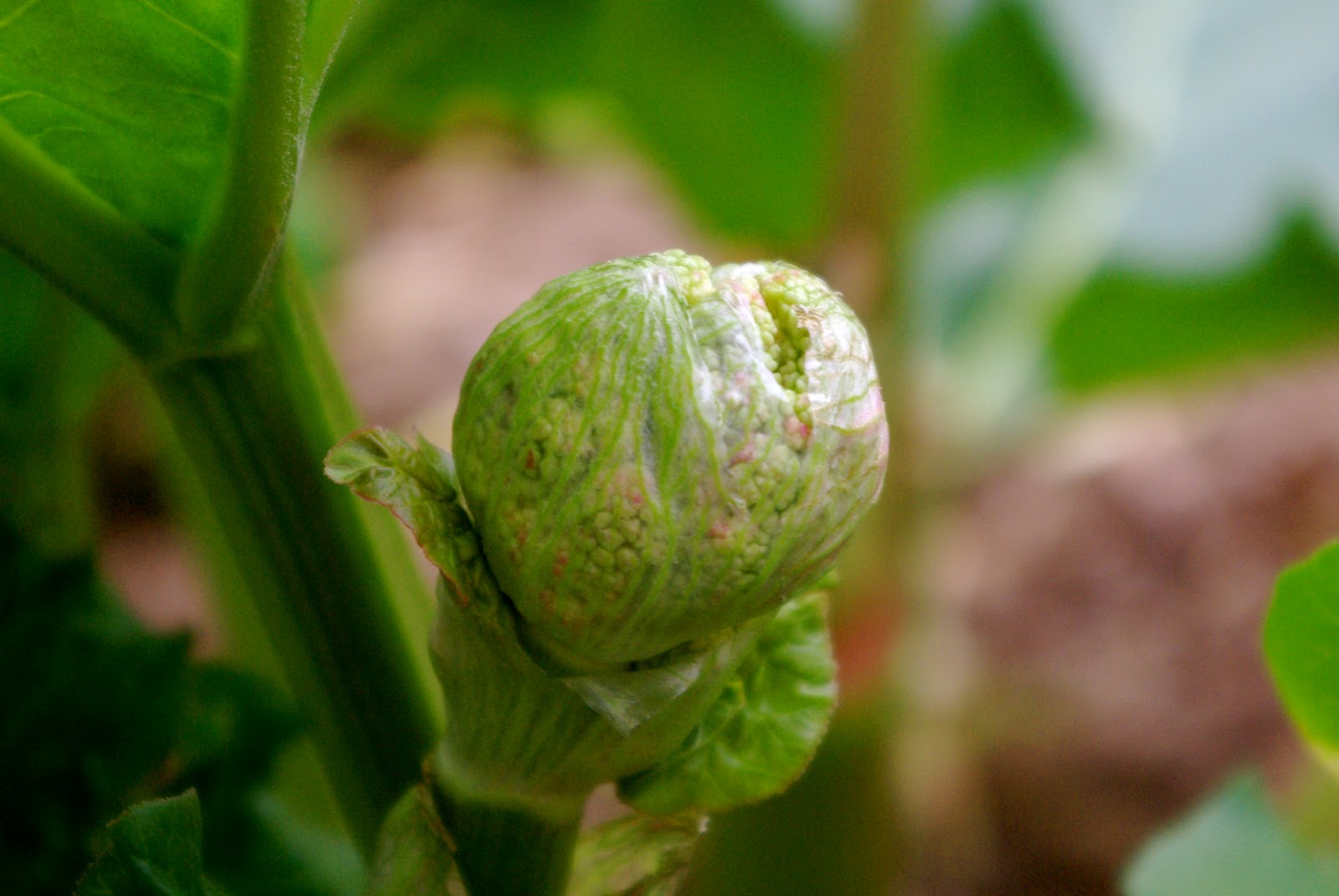
The flower buds of Canadian ginger and rhubarb.
Nature reveals Its creation only when the time is right.
(Click images to enlarge and reveal detail.)

The Protective Seed Hull

Having grown many plants from seed, I have observed that on seedlings, some hulls take longer to drop away than others.  Trying to help the seedlings, a number of times I tried to remove the hull.  The lesson learned?  Some seedlings take a little longer to develop and need the hull to provide protection and perhaps further nutrients, but they are still perfectly normal.  If I do not remove the hull, occasionally the seedling never advances and eventually wilts away.  If I do remove the hull, even if it is still barely attached, the seedling is damaged and usually does not survive.  Even if a baby boy does not die from circumcision (in the U.S., over 117 boys a year die from circumcision), when a functioning part is amputated, the body is damaged.  In early life, the foreskin is fused to the glans (head of the penis) in the same way a fingernail is fused to the finger, and forcefully retracting it causes damage.  This is why some natural ("uncircumcised") males have problems and are circumcised later in life.  In other cultures (the majority of the world does not circumcise), the foreskin is left alone, and problems are virtually unheard of even in old age.  Like the seedling, the boy himself knows when the time is right to retract his own foreskin.  (There are rare cases of phimosis, but this can only be diagnosed after puberty and can be treated without cutting.)

The Emerging Hosta

Walking through the yard, I noticed that hostas emerge very phallic like.  As I looked closer, I realized the comparison was even more than I first observed. To protect the hosta as it pushes through the soil, it is covered in a sort of protective sheath.  As the hosta grows out of the sheath, the more mature outer leaves continue to encapsulate and protect the delicate, still forming inner leaves from a late frost or a few nibbles from a hungry critter.  As the outer, sometimes slightly damaged leaves unfold, the fresh inner leaves reveal their beauty.  It would not make sense to remove the sheath or outer leaves early to "protect" the plant.  Just like those outer leaves, the foreskin protects the penis from frostbite, zippers and even the wear and tear of daily life which causes desensitizing keratinization (NSFW) on an unprotected glans.  As the foreskin is studied, even more ways in which it protects and serves are being discovered.  The major difference between the foreskin and those outer leaves on the hosta is well stated in this quote, "The foreskin is not the wrapper, it's the candy."

More hostas emerging.

A peony emerging from the soil, then from the protection of its sheath.


The protective sheaths of emerging lily of the valley, baptisia and Solomon's seal.  One can observe this again and again throughout Nature.  If plants and animals are designed or evolved so perfectly, why would the human male be any less?

Nature and Hygiene

One of the most often used excuses for amputating the foreskin is hygiene. While soap and running water are no doubt a benefit to humanity, there are still valuable lessons to be learned about hygiene from Nature.  Animals do not use soap and water to bath as humans do, yet I have never heard of one getting an infection of the foreskin or needing to be circumcised.  But then, people do not tend to tamper with animal foreskins to create those problems.

Females produce smegma, too, yet despite all the products sold to "prevent odor," few advocate genital cutting to promote female hygiene.  Though it is more difficult for a female to get to all of her folds and crevices than a male to retract his foreskin, she is entrusted to do so.  People should not insult their sons by assuming they will grow up to be incompetent slobs.  Of course, any part from teeth to toes are "easier to clean" if removed, but to quote Craig Ferguson, who is intact, "You can have this chopped off or you can wash it ... That's a tough choice there, doctor." Amputation is not hygiene and everyone needs to wash, cut or not.

Natural vs. Circumcised

I ask that you view the comparative photos in the following links ... Keratinization and Circumcision Status (NSFW) and Introduction to the natural, intact penis (NSFW).  If you hear the thousands of words these pictures speak, you will agree there is good reason intactivists consider circumcision genital mutilation.  Perhaps in the natural, you will even see the similarity of a rose bud in its perfect form.

Planting the Seeds of Change

I was about ten years old when I first learned of circumcision.  The first thought to come into my non-indoctrinated mind and out of my mouth was, "What if he doesn't want to be circumcised?  It's his body and it can't be undone."  I knew nothing of the pain or loss, only that it was not necessary and that it was wrong to cut other people's body parts off.  That was enough for me to decide then and there that if I ever had sons, they would not be circumcised.

It is only through questioning that we can see where there is fallacy in long held beliefs and create change.  When it comes to circumcision, frequently questions and change are met by mockery and anger.  The person who says, "Baby boys are born perfect.  Love them enough to keep them that way." is considered crazy, penis obsessed, and even perverted while the person who says, "Baby boys are born ugly, dirty and unhealthy.  You should amputate the most sensitive part of their manhood before they can refuse." is considered normal, sane and their motives are never questioned.  How backwards is that?!  Our boys and men deserve better!  I ask that you challenge any beliefs you may hold regarding circumcision with the following questions.

  • The same "health benefits" and ridiculous excuses are given to promote both male and female circumcision.  Insurance companies even covered female circumcision in the U.S. until the 1970s.  Since 1997, all forms of female circumcision performed on a minor have been banned by U.S. law; this includes even a symbolic pinprick of the clitoral hood (female foreskin) for religious reasons.  The 14th Amendment grants equal protection, so why do males not receive it?
  • For what other normal, healthy body part would we think amputation was a parental right for any reason?
  • What other unnecessary cosmetic surgery, trauma or abuse would we allow upon a child because he could not say "no" and "won't remember" the event?
  • Would we consider it acceptable to amputate the foreskin of an adult without his consent?
  • Why does the adult that the circumcised child will grow into not deserve the same right to his foreskin?
  • Why do anatomy books and charts in the U.S. show the penis sans foreskin as though that is the natural state?
  • Why are U.S. doctors and nurses taught to amputate the foreskin rather than of its functions and how to preserve it?
  • For what other body part is amputation promoted as "cleaner," "preventative medicine" or a "cure" rather than washing and treating as needed?
  • We do not refer to other body parts as "unamputated" (e.g. unmastectomized, undecapitated), so why is a man with his whole penis referred to as "uncircumcised," as though a surgically altered penis is natural?
  • What other amputation, especially upon a helpless child, are "jokes" not only acceptable, but common about?
  • What other body part would it be acceptable to ridicule or scorn a person for having?
  • Why are the feelings of men who feel violated by circumcision swept aside rather than acknowledged as they would be for any other amputation, especially if performed needlessly without the owner's permission?
  • If a society has a perverted view of a normal, healthy body part, is it not the society that needs to be changed rather than forcibly amputating the body part from the society's most vulnerable members?
  • Why so many double standards, all against the human male foreskin?

Basic Human Rights

This is about human rights.  No medical organization in the world recommends routine infant circumcision; it is medically unnecessary.  Circumcision is a personal choice.  Sadly, some confuse a personal choice with a parental decision, which is not the same thing.  When the parental decision is to circumcise, the right of personal choice is stolen from the only person whose opinion matters, the person who has to live with the decision, the person himself.  This violation is something that even the most violent criminal is protected from.  His body, his choice.

"When You Know Better, You Do Better."
-- Maya Angelou

I am not judging anyone who had their son(s) circumcised because they did not know any better. Since the late 1800's when it was promoted in the U.S. to prevent masturbation, circumcision has been a "cure" searching for a disease, and whatever the scare of the era, it was said to prevent.  There is still a lot of misinformation promoting circumcision that is spread as fact, even by those who should know better.  It takes a very strong person to admit they have made a mistake and a very strong man to admit he has been harmed.  I have the utmost respect for those who have done just that and have chosen to protect their sons rather than continue a painful cycle.

Circumcision ...
The more you know, the more you're against it!

Resource links ...

Attorneys for the Rights of the Child
Beyond the Bris
Bonobo3D
Boys Deserve Better
Catholics Against Circumcision
CIRCINFO
CircLeaks
Circumcision Harm
Circumcision Information and Resource Pages
Circumcision Resource Center
Circumcision Wisdom
Circumstitions
Doctors Opposing Circumcision
DrMomma - Peaceful Parenting
End Routine Infant Circumcision
Global Survey of Circumcision Harm
In Memory of the Sexually Mutilated Child
Intact America
Intact Network
Intact News
Intactivist Pages
Internation Coalition for Genital Integrity
Involuntary Foreskinectomy Awareness
Jewish Circumcision Resource Center
Jews Against Circumcision
Lucky Stiff
Men Do Complain
Mothers Against Circumcision
MGM Bill
Moralogous
New Foreskin (foreskin restoration)
National Organization of Circumcision Information Resource Centers
NOCIRC-PA
National Organization of Restoring Men
NORM: New England (NSFW)
National Organization to Halt Abuse and Routine Mutilation of Males
Not Just Skin
Nurses for the Rights of the Child
Question Circumcision
Rape of Innocence
Restoring Foreskin
Restoring Tally
Saving Babies
Saving Sons
Secret Penis
Sex As Nature Intended It
SICSOCIETY
TLC Tugger (foreskin restoration)
The Whole Network